
Madison, Madison County · September 2025
Madison Farmhouse: Half-Round Restoration with Modern Drainage
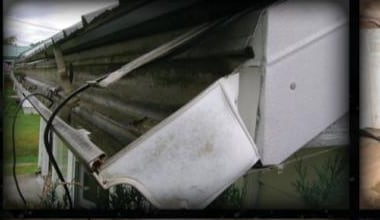
The problem
1910s farmhouse on 14 acres in Madison County had original galvanized steel half-round gutters that had finally rusted through after a century of service. Water was sheeting off the eaves during rain, washing siding paint, and causing a steady wet zone that was undermining a stone walkway. Customer wanted to honor the historic appearance. Explicitly did not want modern K-style. While gaining real long-term durability.
What we did
Custom-fabricated copper half-round gutters across the entire perimeter, soldered miter joints at all corners, copper fascia bracket hangers spaced 16 inches (tighter than residential standard, given the snow load at 800 ft elevation). Round copper downspouts to match. Buried 4-inch PVC discharge lines for both downspout outlets running 25 feet to a pair of underground drywells past the historic stone walkway.
How it turned out
System has weathered one full season including a December ice storm and two heavy June thunderstorms. Copper has begun its initial patina shift from bright to brown. Customer reports no overflow, no streaking on the painted clapboard siding, and the previously-wet zone near the walkway is dry. Expected service life on this install is 80-100+ years.
Why this job mattered
Most of the gutter work we do is pragmatic. Install the right system at the right price for a working family. Once or twice a year, we get a project that’s about restoration and craft. This was one of those.
The home is a 1910s I-house style farmhouse with original architectural details still intact: hand-laid fieldstone foundation, original wood clapboard, period-correct trim profiles, and original galvanized steel half-round gutters that had served their purpose for over a century before finally giving out. The customer had inherited the home from her grandparents and was committed to restoration over modernization.
She told us at the estimate: “I don’t want a contractor to come out here and put modern aluminum K-style on this house. If that’s what you’re going to recommend, please tell me now and I’ll keep looking.”
We told her we don’t do that. The right answer for a house like this is half-round, ideally copper, with proper restoration of the cornice work behind it.
The plan
Three weeks of design conversation before installation began. Decisions made:
- Material: Copper. The customer was committed to long-term durability and historical accuracy. Copper half-round, soldered joints, copper hangers and downspouts.
- Profile: 6-inch half-round (slightly oversized vs. a standard 5-inch) to handle the heavy summer thunderstorms and the snow-melt volumes at 800 feet of elevation.
- Hanger spacing: 16 inches instead of standard 24. Madison’s snow load argues for tighter spacing on a historic structure where we don’t want stress concentrations at any single hanger.
- Drainage: Underground discharge to pair of drywells past the historic stone walkway. The customer didn’t want pop-up emitters or visible discharge in the cottage garden.
- Cornice work: Three sections of original cornice trim needed minor wood repair before new gutters could be hung. We coordinated with a finish carpenter the customer had worked with previously.
Materials
We ordered 16-ounce copper sheet stock for the gutters and downspouts. Copper hangers and brackets matched. All joints planned for soldering rather than mechanical fastening. Soldered copper joints are watertight in a way modern caulked aluminum corners simply aren’t.
The install
Three days on site:
Day one: Removal of original galvanized half-round system. Cornice repair coordination with the carpenter (he was on site simultaneously). Trenching for the underground drainage runs to the planned drywell locations.
Day two: Drywell construction (gravel-filled pits, 4 feet deep, lined with filter fabric and capped with sod-friendly grates). Underground PVC discharge runs back-filled. Copper hanger placement on the cornice. Careful sighting work to ensure straight runs across slightly imperfect 100+ year old fascia.
Day three: Copper gutter installation. Soldering at corners (we work with a propane torch and lead-free solder for this work). Copper downspout installation with custom-fabricated bottom elbows transitioning into the underground PVC. Walkthrough with customer.
What it cost
This was a five-figure project. We don’t publish the exact number out of respect for the customer’s privacy, but for a customer considering similar work: copper half-round restorations at this scale are 4-6x the cost of equivalent aluminum K-style installations. The cost is mostly material (copper is genuinely expensive); some is the slower install (soldered joints take time); a smaller fraction is the specialty tooling and skill involved.
For the right home and the right customer, the math works. For a typical 1990s subdivision home, it doesn’t.
Photo documentation
Shot before, during, and after. We are holding the gallery until customer permission to publish is on file.
What we’d do again
The hanger spacing decision was the right call. Snow load at this elevation is real and we’ve seen lighter-spaced systems fail on similar properties. Copper held up perfectly through a December ice storm that would have stressed an aluminum system.
The underground drywell drainage was the right call. Surface discharge in a cottage garden setting would have been visually wrong and functionally inferior on the heavy clay soil at this property.
The carpenter coordination was the right call. Cornice and gutter work need to be planned together on a historic restoration; trying to retrofit one onto the other always produces compromises.