
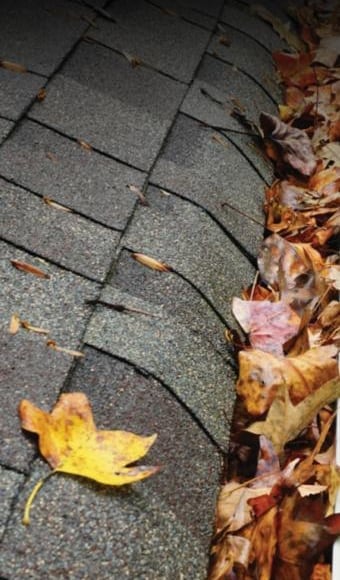
How we clean gutters (the right way)
Gutter cleaning is one of those services where the cheap version isn’t worth the money. The pattern we see when we’re called in to fix a botched job:
- Debris blown onto the roof or scattered across the lawn instead of bagged.
- Downspouts not flushed. Debris compacted into the elbow waiting to clog at the next storm.
- No inspection. Homeowner doesn’t know there’s a separated seam or a rotted fascia behind the gutter.
- No documentation. Homeowner has no proof anything was actually done.
Here is what a full cleaning scope can include. Your work order confirms the services and documentation for the property:
1. Hand removal of all debris. We work top down with hands and small scoops, into buckets or bags. We haul it off the property. We don’t blow it.
2. Downspout flush. Every downspout gets a hose run through it after the gutter is clear. If anything is plugged at the elbow, we open it. If we can’t open it from the top, we drop the downspout, clear it, and remount.
3. Top-to-bottom inspection. While we’re up there we look for separated seams, hanger pull, fascia rot, sagging sections, and missing end caps or drip edge. We document anything we see.
4. Photo documentation when included. The work order identifies which accessible runs will be photographed and how the images or inspection notes will be delivered.
5. Clean cleanup. Tarp under the work area, lawn check before we leave.
Cleaning is also the fastest way to learn whether the gutter is actually failing. If the run flows after cleaning, you may only need maintenance. If it still sags, spills behind the fascia, or backs up at the downspout, our repair vs replacement checklist explains what we inspect next.
If you already know the gutters are old, loose, or leaking at several corners, look at seamless gutter installation too. We will still clean and clear the active issue, but we will not pretend maintenance fixes a failing system.
How often you actually need cleaning
This is the question every homeowner wants a straight answer on. Here’s how we think about it:
Twice a year (spring and fall):
- Heavy pine, cedar, or eastern hemlock canopy directly over the home.
- Multiple oak or sweet gum trees within 30 feet.
- Black walnut or hickory in the yard.
- Roof valleys that funnel debris from a large catchment.
- Older homes where the gutter system is undersized.
Once a year (typically late fall):
- Moderate deciduous coverage.
- Light pine. A few trees but not a forest.
- Modern homes with properly sized gutters and downspouts.
Every other year or as needed:
- Open lots with no significant overhanging trees.
- Homes with quality gutter guards in place (still need a top-rinse and inspection).
We tell you what your home actually needs. We’d rather have a customer for ten years on annual cleaning than overcharge for unnecessary visits.
For a month-by-month schedule, read our Central Virginia gutter prep checklist or the deeper guide on how often to clean gutters in Central Virginia. If you are in town or central Albemarle, the local breakdown is here: why Charlottesville gutters clog faster than homeowners expect.
Cleaning recommendations by local tree zone
Charlottesville and Albemarle hardwood canopy. Rugby, Locust, Belmont, North Downtown, Ivy, and older Albemarle neighborhoods usually need spring and fall service because tulip poplar, oak, sycamore, and roof grit hit at different times. See the Charlottesville gutter page for the pattern we see most often.
Greene, Madison, and pine-heavy mountain lots. Pine needles mat together and clog elbows even when the gutter looks only half full from the ground. These homes are the best candidates for a maintenance plan, and sometimes for Xtreme micro-mesh gutter guards.
Lake Anna and Lake Monticello weekend homes. Owners often are not there after storms, so documentation can matter. The work order can include cleaning, downspout checks, photos of safely accessible runs, and visible-condition notes about whether drainage or guard work may reduce repeat calls.
Orange, Barboursville, and open farm lots. Lighter tree pressure can often stay annual, but long roof planes and wind-driven leaves still create problem corners. We check downspout outlets and fascia while we are up there.
What it costs
Most standard residential cleanings in our service area fall in the $175 to $425 range. Smaller one-story homes with easy access are at the lower end. Two-story homes, steep pitches, walkout basements, and packed systems land higher. The variables that drive price:
- Roof height and complexity. Two-story or three-story homes take longer and require taller ladders or roof access.
- Debris load. A first-time cleaning of an overgrown system costs more than a repeat customer’s annual visit.
- Property access. Walkout basements, tight side-yards, or fenced rear yards add complexity.
- Special conditions. Steep roof pitches, slate or tile roofing that we have to work around, or hard-to-reach valleys.
For a deeper breakdown, read how much gutter cleaning costs in Charlottesville. We quote up front. If we get on site and the job is bigger than the estimate, we tell you before we start, not after.
Recurring service plans
Some cleaning customers prefer a twice-a-year service plan. The work order can set the target seasons, access instructions, communication method, photo documentation, and billing process. We still confirm the actual appointment according to weather, route, access, and the agreed service terms.
Recurring cleaning is also how we catch early failures before they turn into larger repairs. Hangers pulling loose, fascia starting to soften, downspouts disconnecting at the elbow, and black streaks on the gutter face all show up during routine service. If we find those, we quote fascia and soffit repair, gutter brightening, or replacement as separate options.
When cleaning is not enough
Cleaning should restore flow. If water still overflows after the gutter is clear and the downspout is flushed, we look for:
- Backward pitch. Water sits in the run instead of heading toward the outlet.
- Too few downspouts. A long run may be dumping too much roof area into one outlet.
- Loose hangers or sagging metal. Cleaning removes the weight, but it does not re-hang a failed gutter.
- Rotted fascia. Fasteners will not hold if the wood behind the gutter is soft.
- Poor discharge. The gutter works, but water exits too close to the foundation.
That is why a useful cleaning scope includes visible-condition notes where inspection is safe and included. The goal is to understand the water problem, not just empty the trough.
Where we clean
Charlottesville, Albemarle, Barboursville, Orange, Madison, Greene, Fluvanna, Louisa, and Culpeper County. We use the same estimating process throughout the service area, while the written quote reflects route, access, roofline, debris load, and the requested documentation.
Related work
- Gutter guards. Significantly reduce cleaning frequency.
- Seamless gutter installation. When cleaning isn’t enough and the system needs replacing.
- Drainage solutions. When the cleaning’s done but the water still won’t go anywhere it should.
- Repair vs replacement guide. When you are not sure whether a fix or a full replacement makes sense.
- Free estimate. Book a one-time cleaning or ask about recurring service.