
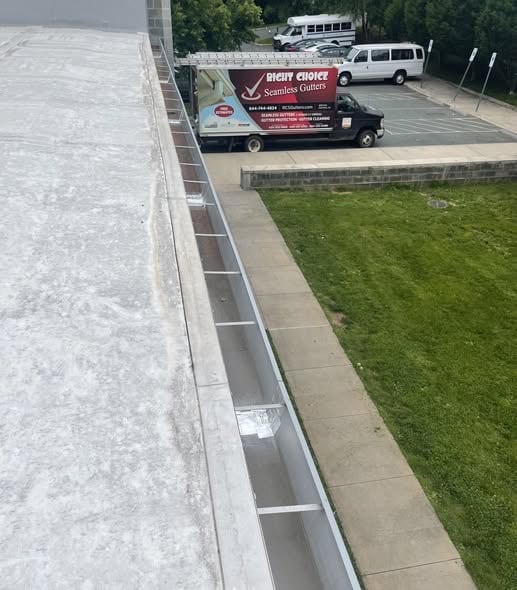
What commercial gutter work actually involves
Most “commercial” gutter work is closer to specialty residential than to true commercial roofing. But the differences matter, and contractors who only do residential get them wrong.
Water volumes are bigger. A church roof with 5,000 square feet draining to one corner moves water at a rate that overwhelms standard 5-inch K-style. Commercial work usually starts at 6-inch K-style and goes up. 7-inch, custom-fabricated box gutter, or true scupper systems where roof water exits through wall openings instead of edge-of-roof gutters.
Runs are longer. A 60-foot residential gutter is a long run. A commercial run on a strip retail building can be 200 feet. Thermal expansion alone moves a 200-foot aluminum gutter by several inches across the seasons. Expansion joints aren’t optional at that scale.
Discharge planning is critical. Where roof water from a commercial building goes is often a code-driven question. Storm sewer connections, retention ponds, dry wells, or daylight-to-grade. Each has implications for permits, sizing, and long-term maintenance.
Hangers and brackets are heavier. Commercial spec hangers are stamped from heavier-gauge stock, spaced tighter, and rated for higher load. We don’t substitute residential hangers because the price difference is small and the failure cost is large.
Project types we handle
Retail and small-commercial. Strip centers, professional offices, restaurants. We’ve worked around active-business hours, dealt with HVAC roof penetrations and mechanical equipment that constrains gutter routing, and coordinated with property management on access.
Churches and assembly buildings. Older sanctuaries with steep roofs and original copper or galvanized box gutters need careful restoration work. Newer church campuses with multi-building layouts need coordinated drainage.
Agricultural. Horse barns, run-in sheds, machinery sheds, hay barns, riding rings. Single-slope and gable structures with long runs. We size up downspouts and almost always discharge underground.
Light industrial. Small manufacturers, warehouses, contractor shops. Often metal roofing, often standing-seam, often with snow-load considerations. Standing-seam metal sheds snow in heavy slabs and we install staggered snow guards above any commercial gutter line on a metal-roof building.
HOA and common-area. Pool houses, clubhouses, gatehouses, maintenance buildings. We coordinate with HOA boards on color matching and submission requirements.
Vineyards, wineries, and event venues. Several wineries in Albemarle and Orange Counties are RCS customers. The work is often on older buildings repurposed into tasting rooms with new water loads. We treat the gutter conversation as part of the building’s adaptive reuse plan.
Box gutters and scuppers
Some commercial buildings (and many older churches and historic structures) use built-in box gutters or wall scuppers instead of edge-mounted gutters. These are a different category of work:
- Box gutters are integrated into the roof structure, lined with copper or membrane, and have to be re-lined when the lining fails. We do this restoration work.
- Scuppers are openings in parapet walls or low-slope edges that discharge roof water. We size and fabricate scupper systems including the wall flashing and downstream collector boxes.
If your building has box gutters or scuppers, that’s a specialty conversation, not a regular gutter quote.
How commercial bids work
For commercial work we usually:
- Walk the property with the owner or facilities manager.
- Measure roof catchment areas and identify the design discharge points.
- Specify gutter size, profile, hanger type, downspout size, and discharge plan.
- Provide a written bid with itemized line items.
- Coordinate scheduling around operational constraints.
The site walk is not optional. We won’t bid a commercial property off a satellite photo, because the things that drive the price — discharge points, access, mechanical equipment on the roof edge, the condition of the wood behind the existing gutter — only show up in person. What comes back after the walk is a written scope with itemized line items, so a property manager or board can see exactly what’s gutter, what’s downspout, what’s drainage, and what’s repair. That’s the document you can put beside competing bids.
Two things commercial customers ask for that homeowners usually don’t: insurance documentation and off-hours scheduling. We carry general liability and workers comp at commercial-appropriate levels, and we’ll send certificates to your property manager, board, or GC before work starts. If the project requires a formal performance or payment bond, tell us during the bid and we’ll arrange it. On scheduling, we plan the install around your operations, not the other way around — early mornings, weekends, or after-hours when the job calls for it. Put your constraints in the bid conversation up front and they become part of the scope, not a surprise on install day.
We’re happy to bid against other contractors. The right comparison isn’t always lowest dollar. Ask each bidder what gauge of metal they’re using, what hanger spacing, and how they’re handling drainage discharge. Apples-to-apples often shifts the math.
For the sizing questions we walk through before bidding, read commercial gutter sizing in Central Virginia.
Snow guards on metal-roof commercial buildings
Light industrial, agricultural, and many newer church and HOA buildings use standing-seam metal roofing. Metal sheds snow in heavy slabs, and a slab catching the front of a 6-inch K-style commercial gutter can pull a 60-foot run loose in one event. We install snow guards in staggered rows above the gutter line on every metal-roof commercial install. The bracket pattern depends on roof pitch and slab length; we typically run two to three offset rows on commercial pitches. Same logic that applies to residential metal-roof installs, scaled to commercial gutter sizes and bracket loads.
Where we do commercial work
All nine counties in our service area: Charlottesville, Albemarle, Barboursville, Orange, Madison, Greene, Fluvanna, Louisa, and Culpeper.
A Richmond multi-family turnaround
On a Richmond apartment complex, the property manager, Sydney, brought us in after another company left the buildings with overflowing gutters that did not even match the trim. Nothing had been re-pitched, so water ran everywhere instead of to the downspouts. We stripped the bad work and reinstalled the whole system across the property: correctly pitched, color-matched to the buildings, and sized to actually move water off a multi-building roofline. It is the kind of botched-install rescue we get called for most on commercial properties.
Related work
- Drainage solutions. Almost always part of a commercial install.
- Fascia and soffit work. Older commercial buildings often need repair before new gutters.
- Half-round gutters. For historic commercial restorations.