
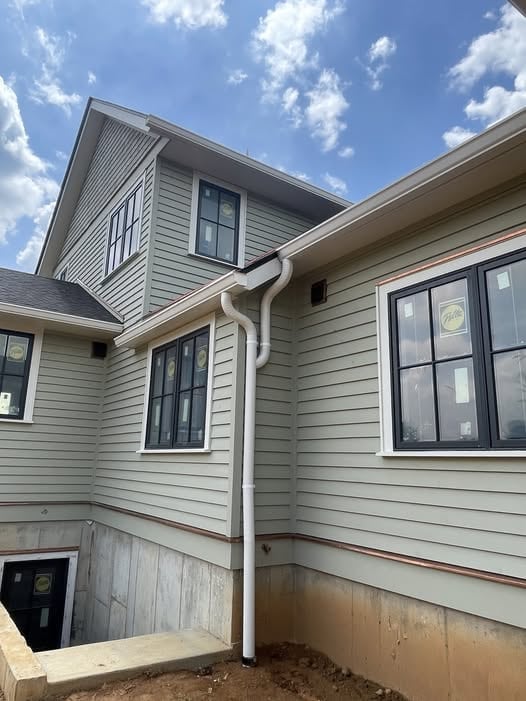
The gutter is only half the system
A clean, correctly pitched gutter can still leave the foundation wet if the downspout dumps roof water beside the wall. That is why we treat downspouts as part of the gutter system, not an afterthought. Water has to leave the roof, enter the gutter, move through the downspout, and discharge where it will not run back to the house.
That last step is where a lot of Central Virginia homes fail. Heavy clay soil does not absorb water quickly. Sloped lots push runoff back toward low corners. Long roof planes can send hundreds of gallons to one outlet during a summer storm. On those homes, a splash block may look finished, but it rarely moves the water far enough.
If the gutter itself is leaking, sagging, or loose, start with gutter repair before burying new pipe. If the gutter is already working, downspout extensions may be the lowest-cost way to protect the foundation.
Options we use
Splash blocks
Splash blocks are the simple choice for small roof areas, level grading, and soil that drains well. They are not wrong. They are just limited. A splash block usually moves water a couple of feet from the downspout, which may be enough for a porch roof but not enough for a two-story roof plane dumping beside a basement wall.
Surface downspout extensions
Surface extensions are the next step. They move water farther from the house without trenching and work well when the discharge can run across mulch, stone, or a low-traffic lawn edge. We use them when the route is simple and when the homeowner does not mind seeing the extension.
Buried PVC discharge
Buried PVC is the cleaner answer when a surface extension would cross a walkway, driveway edge, mower path, or main lawn area. The downspout ties into a solid buried pipe, usually routed to daylight, a swale, or a pop-up emitter. This overlaps with our broader drainage solutions work when several downspouts need a coordinated plan.
Pop-up emitters
A pop-up emitter lets a buried line release water near the surface when there is no clean daylight outlet. It sits low in the lawn when dry and opens under flow. The pipe still needs enough slope and a sensible discharge location; a pop-up is not a shortcut around grading.
Foundation runoff, clay soil, and grading
Charlottesville and Central Virginia properties often combine roof runoff with clay soil and imperfect grading. That means the first few feet around the house can stay wet long after rain stops. Paint failure low on siding, moss beside the foundation, mulch washing out, or a recurring wet basement corner can all point back to downspout discharge.
We look at the roof area feeding each outlet, the grade around the foundation, soil behavior, and where water can legally discharge. On Charlottesville homes, older brick foundations and tight side yards make the route matter. On rural Albemarle and South Albemarle lots, longer runs to a swale or daylight point may make more sense.
When drainage solutions are needed
Downspout extensions solve roof water at the downspout. They do not solve every water problem. If water is moving through the soil from uphill, collecting behind a retaining wall, or entering from groundwater pressure, the project may need French drains or broader drainage work. If water is getting behind the gutter because the wood is soft or the drip edge is wrong, we may need fascia and soffit repair before discharge work.
For new systems, we usually pair discharge planning with seamless gutter installation so the outlet count, downspout size, and final water route are designed together.
What we check on an estimate
- Whether splash blocks are enough or water needs to move farther.
- Whether a surface extension creates a trip, mower, or appearance problem.
- Whether buried PVC can maintain slope to daylight or a pop-up emitter.
- Whether clay soil and grading push water back to the foundation.
- Whether the real issue is loose gutters, rotted fascia, or undersized downspouts.
Start with a free written estimate. We will follow the water from roof edge to discharge point and separate simple extension work from larger drainage problems.